After finishing Ironman Wales (well, after my legs had recovered and I’d warmed up enough to want to ever race again) I knew my next full distance race was going to be Leeds. They’d just announced that England’s only (branded) full distance was going to move from Bolton to my home town, and the chance to race through the streets I grew up in was just too tempting.

2025 wasn’t going to be my year, though. I’d have just started a new job, and after doing Outlaw and Wales in the previous two years I had been told decided that a year away from Iron-distance racing would be sensible for me and my family. So I focused on Leeds in 2026 (with just Outlaw Half, T100, and a few cycling events along the way in 2025).
The proposed date for opening the race in July came and went. I sent a couple of emails to Ironman asking if the race was still going ahead, and wasted too much time trawling speculation about cancellation on Reddit. Eventually the announcement was made that it was moving to August and I signed up as soon as the early-access email landed in my inbox.
Before you know it, a year had rolled around, and I was walking over the hill in Roundhay Park to register. Only with an email sent the previous evening, warning us that they were testing the water quality.
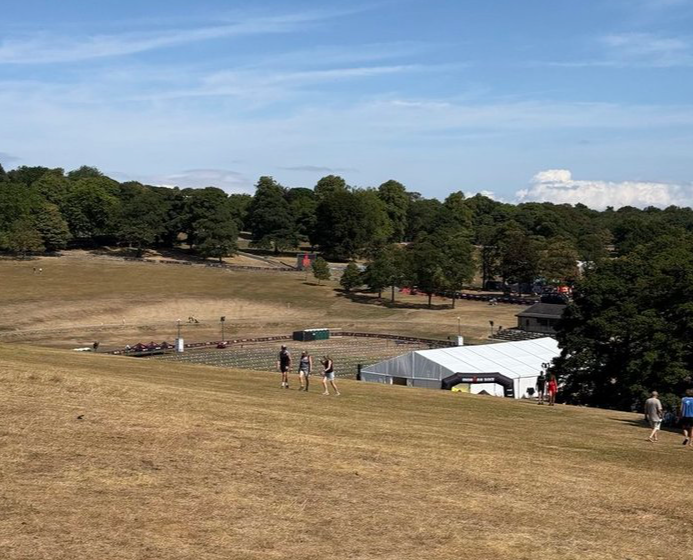
As I picked up my bag, stickers, and ironically swim cap, it sounded ominously like the Ironman I’d signed up for was about to become a duathlon (only without the first run leg, like Outlaw arranged when the same fate befell them).
So here’s my review of the race. But also a bit of commentary on how almost everything that made this race notable - the cancelled swim, the design of the course, the atmosphere, the argument about whether any of it “counts” when getting a copyright-infringing tattoo on your calf - comes back ultimately to questionable decisions about where to host a mass-participation event, and how profit-making organisations might act when the natural world decides not to cooperate.
The swim that wasn’t
I can’t write a race review without mentioning the swim cancellation, and a lot of the upset and anger that came with the way it was handled.
On Thursday afternoon, we were all emailed to say that there was “recent growth” of blue-green algae in Waterloo Lake, and that tests were being carried out. And on Saturday, just under 24 hours before the race and while I was about to set off for the practice swim, Ironman announced the swim was off via Instagram (and then eventually by email, which became one of the many grievances people had about this decision).
The problem was attributed to prolonged hot weather causing an algal bloom, and the test results from Friday put concentrations significantly above the threshold at which a swim could safely proceed.
I did go have a look at the lake after racking my bike. It was a horrible solid green colour, and stank. So I can completely understand why the tests deemed it unsafe for swimming.
Why that lake, and why this week?
A brief bit of biology and geography, before we get to the race itself. The species of cyanobacteria (otherwise called “blue-green algae”) that bloom in British lakes (Microcystis, Dolichospermum, Aphanizomenon) can produce hepatotoxins and neurotoxins. The WHO recreational-water framework grades the probability of adverse effects from these based on the concentration of bacteria in the water. When it’s so high that there is visible scum the recommended action is immediate control of contact, and possible prohibition of swimming.
Two things make a 3.8km mass-participation swim much riskier. The first is dose: you are in the water for over an hour, breathing hard, with your face in a churning washing machine of a couple of thousand people that does a very good job of breaking cells open, liberating their potentially toxic contents. The second is the use of wetsuits. The WHO guidance specifically notes that wetsuits tend to worsen skin effects by accumulating cyanobacterial material against the skin and enhancing cell disruption.
But why was it an issue in Waterloo Lake specifically? Cyanobacteria need three things: warmth, nutrients, and a still water column they can win in. Roundhay in August 2026 supplied all three:
- Nutrients: The Friends of Roundhay Park has been running monthly chemical testing across the lake and its feeder system for years. They have found raised nitrate levels in the watercourses feeding the lake where combined sewer overflows discharge, as well as in the eastern end of Waterloo Lake.
- Heat and drought: The Met Office recorded 38.1°C at Kew Gardens three days before the race, capping an exceptionally dry season across England. The English summer mean temperature was 2.46°C above above the 1991–2020 average putting the season on course to be the warmest on record. The resulting drought lead to low flow in the feeder becks, meaning longer residence time in the lake, less flushing, and a water column that stays stratified.
Annoyingly, there is precedent. A month after the inaugural Leeds race a bloom appeared on Waterloo Lake. The 2026 race was then moved by three weeks directly into the window in which the lake had visibly bloomed the previous year.
So should IM have known this was going to happen? Bloom onset is tricky to forecast, so nobody was going to call this a problem for certain in June. But the question is whether the risk was foreseeable, and it plainly was - from the antecedent weather, from the previous year’s bloom in the same weeks, and from two years of freely available citizen science showing chronic nutrient enrichment. Weekly sampling from mid-July would have been trivial for IM to implement, and the swim potentially cancelled a couple of weeks before the race if it was clear that the algae were becoming a problem.
Understandably, people were annoyed. It’s not a triathlon if one third of the three sports is cut. Swimming is my least favourite bit, and yet I’d psyched myself up for over a year and wanted to jump back into that lake. But on reflection, I think they made the best call they could have in the absence of monitoring in the run up.
There were plenty of arm-chair scientists on social media declaring that “Ironman should have done something”, but there is no intervention that clears a cyanobacterial bloom from a lake of that volume in a fortnight, let alone a weekend. Algaecides are contraindicated, as killing the cells dumps the intracellular toxin straight into the water, while using ultrasonics and aeration are long-game measures and almost certainly cost prohibitive. So we need to accept the lake was not fixable.
The outrage then should be more focused the timing of the cancellation, and here we need to consider the incentives driving decision making. Ironman said that they were leaving it as late as possible to cancel to maximise the chance of the swim happening. However, cancelling the swim on Wednesday lets a few hundred people not drive to Leeds, not pay for a hotel, and possibly find excuses for a deferral - which costs Ironman money. A Saturday cancellation, once everyone has traveled, paid and registered, costs them almost nothing. The two reasons are not mutually exclusive, and the charitable interpretation that they held on as long as possible to preserve the chance of a swim is not entirely incompatible with the cynical one. It’s the same decision. But when the decision that maximises optionality also happens to be the one that minimises refunds, you don’t get to claim the credit for the first without acknowledging the second.
The most balanced take I saw came from a coaching account in the replies under IM’s own post, acknowledging that the same people demanding action would have been demanding answers if the swim had gone ahead and a few hundred athletes had spent the following week ill: ‘“Ironman should have done something” would have become “Ironman should never have let us swim in there”’. Outdoor events carry uncontrollable factors. You can’t make a lake safe by wanting it very much. Whether a partial refund is owed is a separate argument, and one nobody expects to win (IM’s T&Cs only offer a refund if 2/3 of the race is cancelled).
For what it’s worth: I’ve swum that lake twice before, at WTCS age-group races. So I was not devastated about missing out on that bit, even if it did dampen the vibes a bit. But I understand entirely why a first-timer who’d spent eight months learning to swim was.
It also raised questions about the bike and run cut-offs now being unfair, given some stronger swimmers bank time in the fairly generous swim cut-off to get round one of the hardest bike courses on the IM circuit. And to Ironman’s credit, they extended the cut-offs once it became clear the day had changed shape. As a strong cyclist with a comfortable bike split I was never near the limits, I more worry about the 2:20 swim, so I’ll defer to the people who were. But it was the right call, and it was made relatively quickly once people raised concerns.
The bike
So the bike became the start. Arrive an hour later than expected, then a two-by-two TT start in registration order.
And it was a bit grim, at least at first. The drizzle started just as Joanne Murphy was trying to hype us up, although it would have been a tricky job regardless to excite a shuffling queue of people pushing bikes in the half-light past a grass bank mostly devoid of spectators. Compare that to standing on North Beach at Tenby at 6.30am with two thousand people on the cliffs clapping to Thunderstruck after belting out the Welsh national anthem. While IM Wales’s swim start is one of the great sights in the sport, Leeds’s rolling TT start was more like queuing at an aiport gate - basically an administrative process, just with AC/DC playing mutedly in the background.
Some of that is the down to the change in format. Looking at last year’s video it seemed much more intense by the lake. A rolling start is inherently anticlimactic, and it wasn’t an intentional design choice. There was also the feeling that some people just didn’t turn up because the swim was cancelled, or spectators stayed away due to the rain. But I can’t help but feel like some of it is the venue. Roundhay isn’t exactly easily accessible for many, especially with the road closures. It’s not like having the entire town lining the seafront (although that might be because they’re locked inside by the race anyway).
The course, in a nutshell
The course itself was essentially three laps of around 55km through the villages north and east of Leeds - Shadwell, Thorner, Bardsey, Wike, Harewood, Eccup, Arthington, Adel, Alwoodley - plus a lead-out and run-in back in.
Course modelling puts the full bike leg at around 2,574 m of climbing over 180 km, with more elevation gain per kilometre than 95% of the IM bike courses in the comparison set, with Black Hill Road the worst of the climbs and taken on all three loops. My Garmin registered 2,742m, which is within the usual disagreement between devices and route files as air pressure changes and trees interfere with satellites. Either way: this is not an easy course.
It is also, structurally, a fairly good course. Wide-ish lanes, on the whole decent surfaces (there were a few whinges about potholes, but those people are welcome to visit the Midlands for a proper bone shaking ride), a decent rhythm to it once you got into it, and the three-lap format means you know exactly what’s coming (a curse as well as a blessing).
Part of me wanted to dislike it. I remember those heady days when routes into the Dales were rumoured, following the route of the 2014 Tour stage. Indeed, there was the accidental leak of potential routes on ridewithgps not long after the move from Bolton was announced, and some of those looked epic:
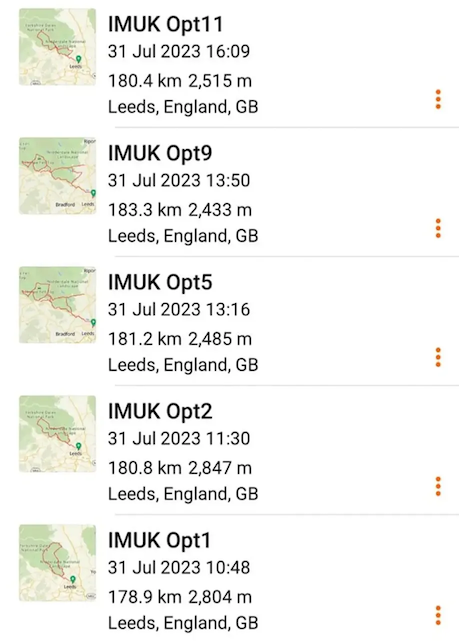
Eventually course was announced as staying close to Leeds with three loops just to the north of the city, on the reasoning that a looped format around gives spectators far more to watch (althought it probably helps that it’s cheaper for road closures). Selfishly I’d have taken the Dales, but commercially, they’re right. And although it was slightly tweaked this year (to make it even harder), once I got stuck into it the level of support and the relentless hills and technical sectors made it exceptional.
The race started with a cautious downhill out of Roundhay, given the fresh smattering of rain on roads that hadn’t been washed for weeks, before a horrible long grind up Wetherby Road to wake up the legs which brought back memories of trips into town as a child. Then it’s a brief hop over the new (since I lived here, at least) Ring Road and into Shadwell, where the laps start.
Laps of climbs: the bit that ruins your run
The key to racing a decent triathlon bike leg is riding in a way that minimises variation in the power you put down and keeps you controlled, thereby saving something for the run. Based on my numbers I was aiming for an everage power of around 190W and a normalised power of 215W, giving me an intensity factor of 0.7. In essence, I want my legs to feel like I’m riding at ~70% of my FTP through not surging and just keeping things steady.
Things did not go to plan.
My Garmin identified three key climbs on the route to worry about:
- Bardsey Hill, immediately after the first of the aid stations
- The long drag up Harrogate Hill past Harewood House, giving you plenty of time to regret the nice fast down immediately preceding it
- And the infamous Black Hill, home to the
Sheephouse Lance Fancy Dress PartyBlackhill Wrestlers
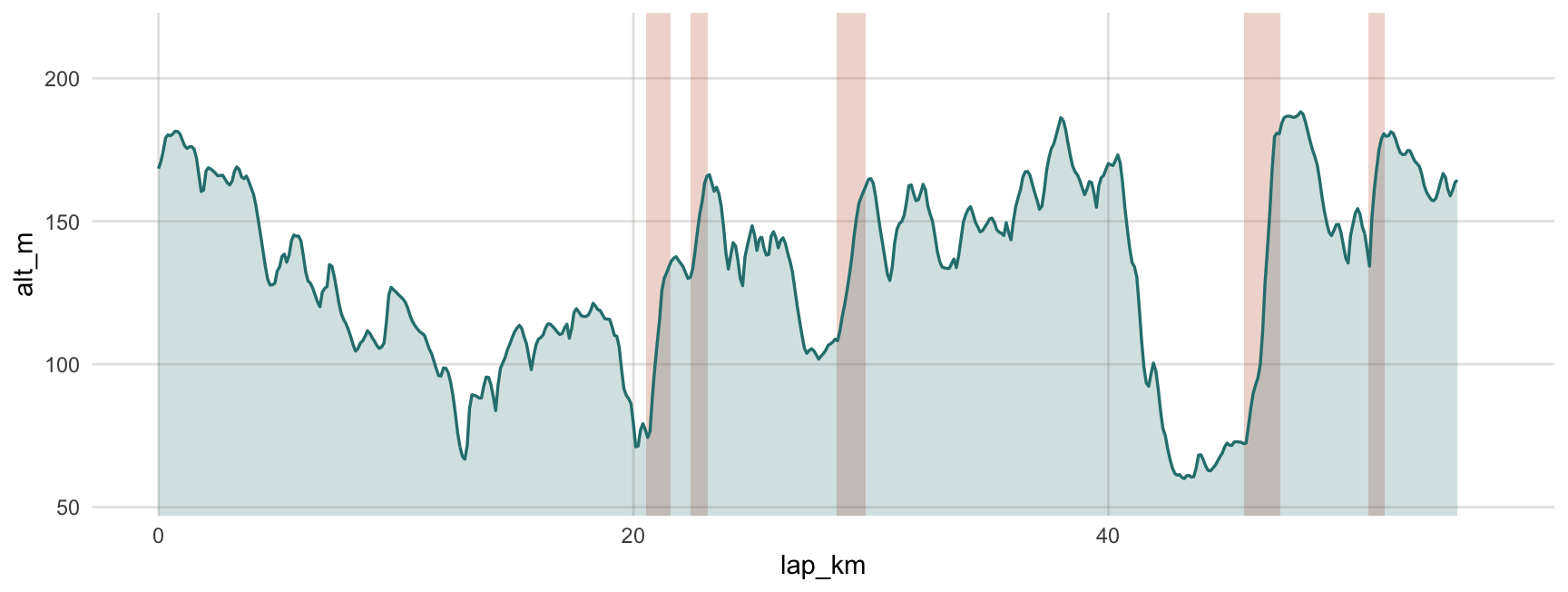
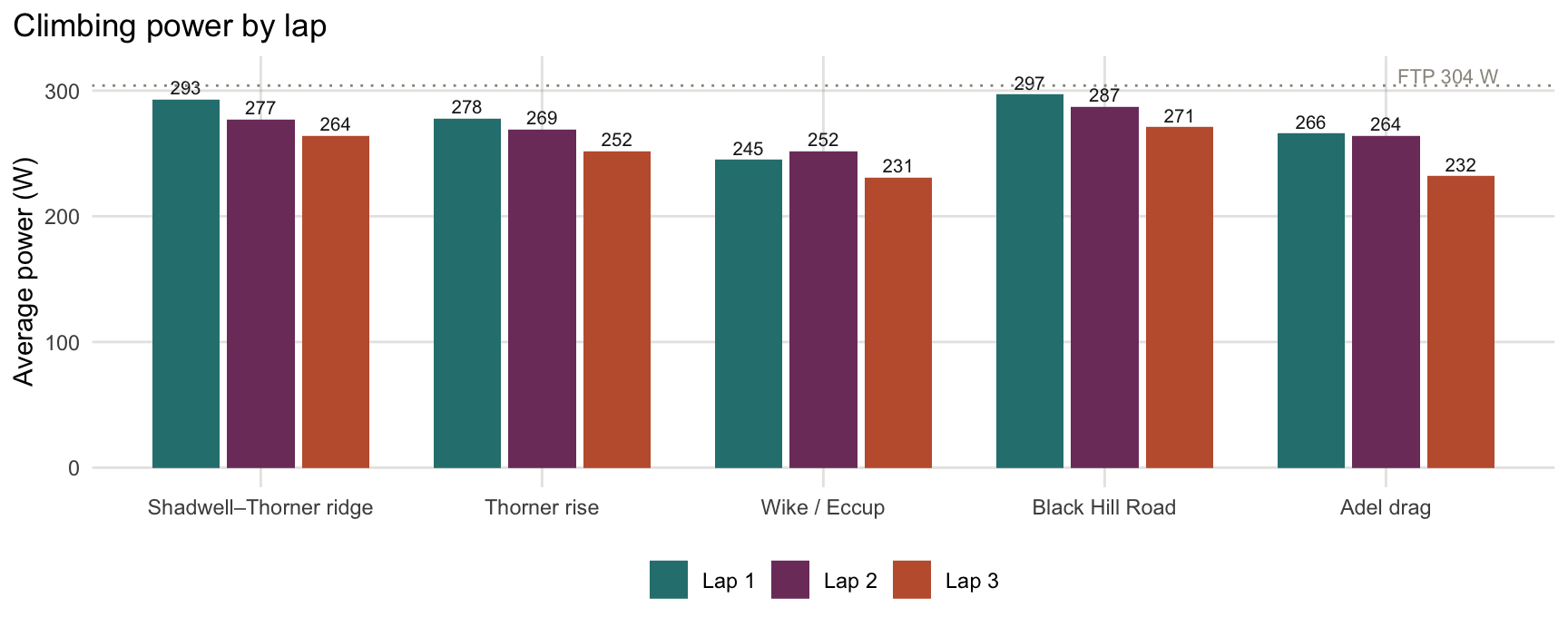
But in reality, the course is relentlessly up and down. This is one of the laps, each one ~810m of climbing over 55km, highlighting the five efforts per lap where each time I went above 250W for a sustained period (while aiming for a maximum of ~230W). And it’s these efforts that decide your race several hours later. While the bulk of Harrogate Hill is long enough to settle in and grind up, the spike as you get to Eccup is what kills your legs, along with the 13% kicker out of Thorner, the double punch of Bardsey Hill, and the harsh climbs that follow once you escape Black Hill Road.
Black Hill Road is deservedly the headline climb on the course. It’s 1.55 km at a shade over 7% average, but is in reality three separate climbs ramping up past 16%. I rode it in 7:09, 7:17 and 7:46 at 297, 287 and 271W respectively, grinding it out at an average of 67, 65 and 63rpm on a road bike I’d have preferred a compact on at that point. Every one of those is 88–98% of FTP, and I did it three times, dying slightly more with each subsequent effort.
Indeed, the same pattern of gradually declining strength lap by lap is a repeating pattern. All five of these efforts come at points on the lap where you’ve already been working hard. So that’s fifteen leg-sapping efforts at or around FTP, embedded in a six-and-a-half-hour ride, which explains why - despite trying to take it easy on the final lap - my legs felt pretty wrecked. But more on my own ineptidue in a bit.
The support
Back to Black Hill Road. That’s the jewel in the crown of support around this course, but to be honest there were spectators everywhere. However having a bunch of people dressed in wrestling masks and capes cheering for me mashing the pedals in time to Reel 2 Real’s classic, even if I barely had the breath to mutter that I too “like to move it move it”, will live with me forever.
Was it as good as Heartbreak Hill out of Sandersfoot? It was so similar, and yet so different. They’re incomparable. But they’re both triathlon bucket list experiences.
The level of support built up over time. On our first lap through the early villages it was thin on the ground, but then I was starting relatively early and the drizzle would also have put people off. But by the second lap, Thorner, Bardsey, and Wike were properly out, with front gardens and streets turned into cheer points with the sort of unbothered Yorkshire enthusiasm that carries you a long way. The roundabout by Eccup was rammed with people, and was so close to Alwoodley Gates that the same people had walked down there by the time you came through the traffic lights over Harrogate Road.
Admittedly by the end of third lap it some of the supporters had started to drift away, mostly because people had sensibly gone to Roundhay to watch the run, but also six hours of cycling is quite a lot for the casual fan or person locked in their house by road closures. Having said that there were still plenty of people happy to cheer or blow horns as you passed them while they walked back towards Leeds. In many ways that’s one of the costs of a spectator-centric course design: the finish is brilliant, but the far end of the course is lonely at the exact moment you need it most. And I finished in a pretty good time, having been lapping people from about half way, so it must have got bleak out there for some of the slower riders who started at the back.
Having said that, there was a uniquely Yorkshire thing I spotted. Without exception, every time the climbing would get tough enough to drop into the small ring, there would be an elderly Yorkshireman with a steel framed bike just hanging out to give you a “champion climbing, son” or “you’re doing grand”. I started to think I was hallucinating these chaps at one point, and had to clarify with another rider that they were real, only for the next one to offer me nothing other slightly surreal “lovely cadence” as I tried to spin my way past.
What the FIT file says
Here is where I have to be honest about my inability to stick to a plan:
| Plan | Actual | |
|---|---|---|
| Average power | 190W | 187W |
| Normalised power | 210W | 226W |
| Intensity factor | 0.70 | 0.744 |
| Variability index | 1.05 | 1.21 |
I hit my average power target almost exactly, but missed the one that actually mattered by 8%. That gap is the variability index: 1.21. On a flat course you’d want VI under about 1.05. On this course, with fifteen climbing efforts a lap, some variability is structural. But 1.21 is not structural. 1.21 is a sign that I kept attacking the climbs at 90% of threshold because I’m a (relatively) strong climber and it felt easier to do it that way at the time.
| Segment | km | min | km/h | Avg W | NP | IF | VI | HR | W/beat |
|---|---|---|---|---|---|---|---|---|---|
| Lap 1 | 54.8 | 122.7 | 26.80 | 195 | 235 | 0.774 | 1.209 | 142 | 1.372 |
| Lap 2 | 54.8 | 119.1 | 27.60 | 192 | 231 | 0.760 | 1.204 | 144 | 1.330 |
| Lap 3 | 54.8 | 128.3 | 25.62 | 175 | 214 | 0.703 | 1.220 | 142 | 1.235 |
| Run-in | 11.2 | 22.7 | 29.63 | 177 | 201 | 0.662 | 1.140 | 143 | 1.236 |
The signal of decaying power across the laps is unambiguous. Efficiency factor (watts per heartbeat, a measure of aerobic durability) went steadily from 1.37 to 1.24. Lap three cost me 9 minutes against lap two while producing 17W less at the same heart rate. I did ease off intentionally, to try to bring my NP down, and I was right to. But by then the bill had been run up, and I was about to pay for it on the streets around Roundhay.
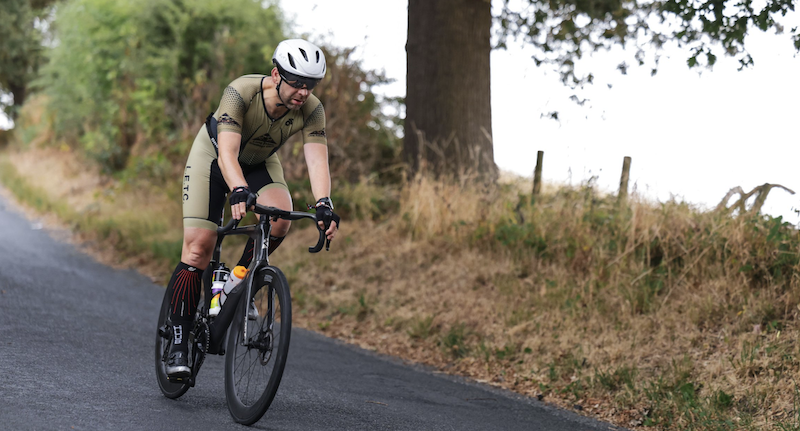
I was hugely relieved to reach the lap marker for a third time, and thankfully the drag home was mostly downhill… until you turn into Roundhay Park proper, and have to climb back up to the start. I might have overcooked it a little here too, but other than nearly getting taken out at the dismount line by a man who failed to unclip properly (flashbacks to the T100 bike start) I was racked and back in T21 just outside of my 6:30 goal.
The run
4 minutes to rack, change socks and shoes, and pick up some nutrition wasn’t bad. Nowhere near the full change and wait out the weather I did in T2 at Tenby.
But then it’s straight up out of Roundhay, which is a horrible way to start a marathon, especially coming off a hard bike. I knew these paths from previous races, but the worst I’d had to do was 10km after a 40km ride. Emerging from T21 with no blood in your legs to be faced by an immediately climb, followed by a gravel lap around the top lake before another climb, was brutal. The only thing feeling worse than my legs as I tried to leave the Park was my back, so I had to stop and stretch out the cramp. I’ve really focused on core work this year during strength training, but clearly not enough.
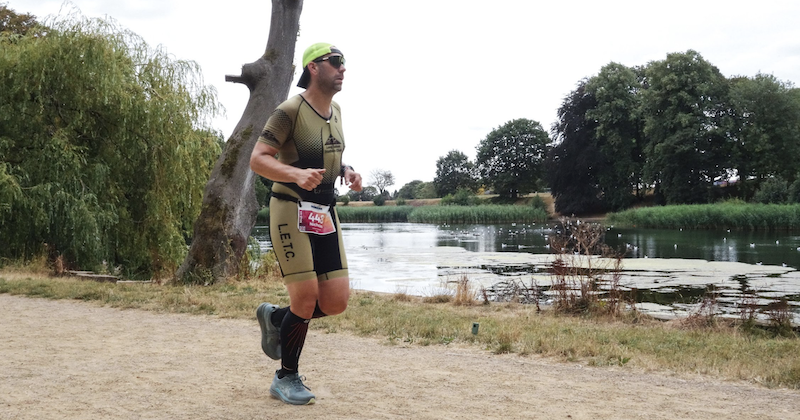
Then it was time for four laps of roughly 10.3km around the park paths and the Roundhay streets. And once again, it was not flat. My Garmin counted 473m of ascent over the marathon, while the same course modelling as before puts it above 89% of Ironman run courses for climbing per kilometre. There’s one particular nagging rise on every lap that feels like nothing on lap one, but can be genuinely defeating by lap four (although I avoided walking it at any point).
Once you’re on the laps it’s actually a great run course. Yes, it’s essentially a housing estate with a brief trip into a park, but there’s closed roads, shade where it counts, and - the real point of the whole Roundhay-centric design - you are never more than about five minutes from a wall of noise.
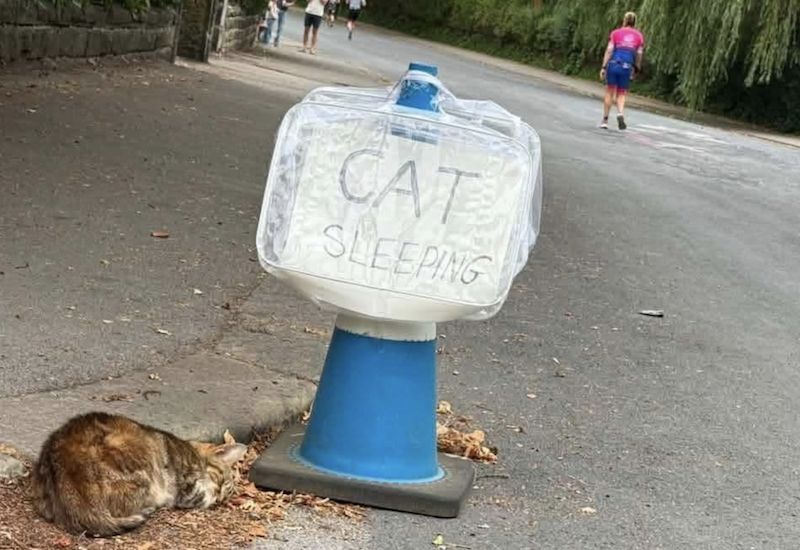
The race starts with the wristband station, which was positioned just beyond the “Cat sleeping” warning cone, then meanders through the houses where every other house seemed to be throwing a party on the street. Each corner was well staffed with fans happy to shout, cheer, high five, or dance with runners, and the elderly Yorkshiremen from the bike had been replaced by well dressed young men and women standing anywhere the support was thin, who’d respectfully tell you how well you were running while reading your name from your race belt. Kids with a hose happily sprayed you down on Metal Corner, and the aid stations were plentiful and well stocked with my classic run fuel of jelly babies, flat Pepsi, and as many Maurten gels as I could fit in my trisuit to take home for later.
Much of the race was two directional, which allowed you to celebrate or commiserate your fellow runners. It also allowed for a few mass gatherings of spectators where the noise was almost all consuming, which kept you moving when you felt like your feet were about to fall off.
Where my race fell apart
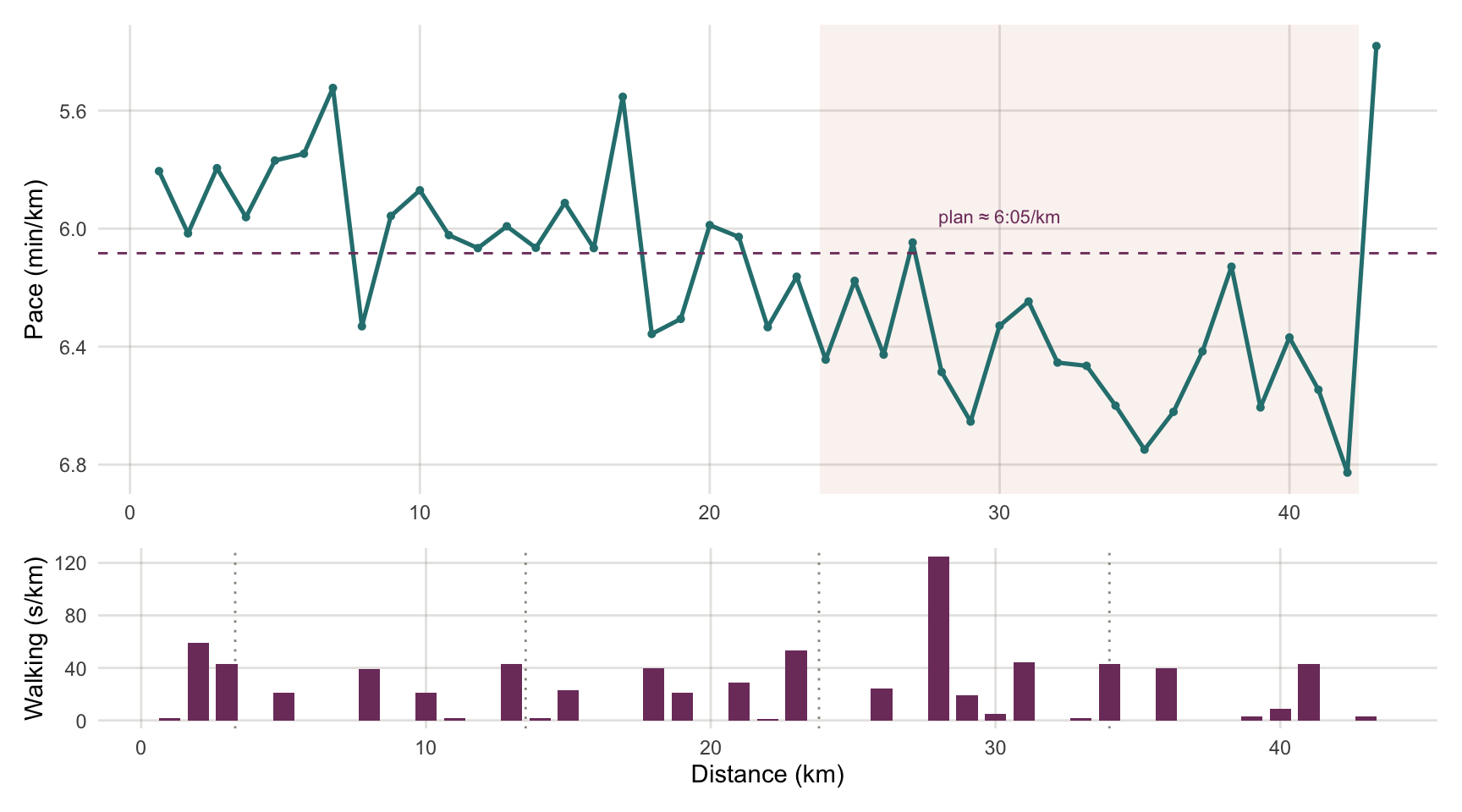
My plan was to try to hold around 6:00-6:10/km while running and walk the aid stations, which I managed for almost two laps. Then it started to drop off:
- 10 km: 61:39
- Half marathon: 2:09:56
- Second half: 2:19:45 (a 10-minute positive split!)
- Finish: 4:29:41
My lap-by-lap running pace fell steadily from 5:56 to 6:29, and walking time (which was all spent in the aid stations) climbed from 128s to 262s by lap three (before falling at the end when I tried to skip a few on the last lap, before overheating and giving in on the last). The inflection is somewhere around 24–25km, at the start of lap three, roughly two and a half hours into the marathon (or nine hours into my day of exercise).
You could easily describe this as two laps going to plan, and two laps of damage limitation:
Why did this happen?
Here’s the interesting bit, and it’s the reason I bother with this data at all.
| Segment | km | min | Overall pace | Run pace | Walk (s) | HR | m/min/beat |
|---|---|---|---|---|---|---|---|
| Lead-out + Roundhay climb | 3.3 | 20.5 | 6:13 | 5:52 | 104 | 144 | 18.64 |
| Lap 1 | 10.2 | 62.6 | 6:08 | 5:56 | 128 | 141 | 19.27 |
| Lap 2 | 10.3 | 64.2 | 6:14 | 6:06 | 167 | 140 | 19.08 |
| Lap 3 | 10.2 | 67.4 | 6:36 | 6:24 | 262 | 136 | 18.49 |
| Lap 4 + finish | 8.4 | 55.0 | 6:35 | 6:29 | 98 | 136 | 18.62 |
My heart rate went down as I slowed. Lap one at 141 bpm, lap four at 136. Peak run HR was 156 (against 184 on the bike). That is not what heat stress looks like, as cardiovascular drift under thermal load pushes heart rate up at constant pace. It is not a cardiac-output ceiling either, because there was clearly headroom.
As we discussed, there’s a similar picture to this on the bike. For the same heart rate I got steadily less output from about lap two of the bike onward. Falling pace at falling heart rate, with cadence intact and no thermal signature, points at the limbs and at fueling issues, not at the pump. The most coherent story is that fifteen near-threshold climbing efforts, doing around 4,400kJ of work over six and a half hours, emptied the tank and beat up the legs, and I then tried to run a marathon on what was left.
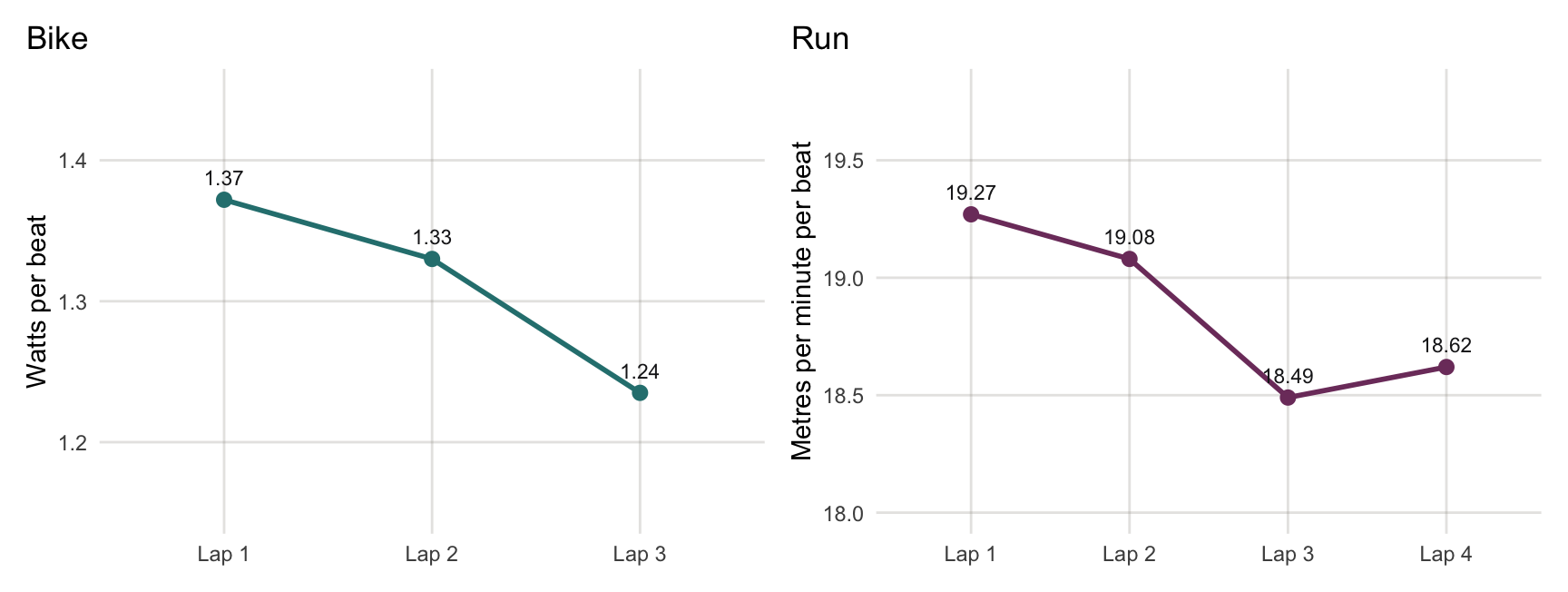
Which makes this a bike pacing error, not a run pacing error. Riding 8% over the NP target on a course with this much elevation is the entire explanation. The fix isn’t fitness, it’s discipline on the climbs: if I could have capped the efforts at ~85% FTP rather than 90–98%, and accept losing a couple of minutes a lap as a result, I could have turned up to T21 with something more in reserve.
There is a counter-argument here: riding lap three of the bike 5% softer would have cost maybe 8–10 minutes, and might have bought back 8–12 on the run. So it might have just been break-even, regardless. And on a course this hilly, some of that fade is just what 2,700m of climbing does to someone slightly overweight in their 40s, and there’s a risk I’m over-fitting a narrative to four data points. But the efficiency-factor curve starts bending on lap two of the bike, not lap three, and that’s earlier than “the course did it” or “I’m old” explains in isolation.
A note on the circus
So many spectators. Genuinely brilliant, all day, everywhere on the run.
There was also an unusual density of famous people. I ran into Marina Andresen in transition, overtook Russ Cook (otherwise known as Hardest Geezer) and Flynn the parkrun guy on the run, was handed a drink by the legend that is Sean Conway, nearly got taken out by Pera Humstad celebrating at this moment, and was cheered on by Ironwoman Kellie Branagan.
I’m ambivalent about this. It isn’t the T100-style celebrity saturation, and nobody appeared to be getting preferential treatment on course. Personally I don’t care who I’m racing alongside, and it’s good for the sport to get some attention.
But what I do get a bit peeved about is the number of athletes who were, at various points, accompanied by a group of non-competing people running alongside them, camera operators trying to match their pace and moving other competitors out of shots, and the number of bikes that appeared to pace runners without a care for the other people on the course. This isn’t a grey area. The Ironman rules are explicit that supporters of any type may not bike, drive or run alongside an athlete, must not pass food or other items, and should stay clear entirely. In fact, the obligation is on the athlete to actively reject any attempt to assist, follow or escort. Racing alongside other competitors who are still racing is fine, and almost necessary at my level to keep each other motivated, but being escorted by people outside of the race is not. Athletes have been disqualified for accepting a great deal less.
So the answer to “should it be banned?” is that it already is. The real question is enforcement in a 2,000-person field on open park paths where the difference between a supporter jogging 400m with their partner and a private pacer is mostly vibes. I don’t have a clean answer. But a course that visibly doesn’t enforce a rule is worse than one that doesn’t have it, because it quietly penalises everyone who assumed the rule applied to them, and getting my own race hindered because someone is “filming content” and needs to take up the road or hit by a mountain bike who shouldn’t be there does take the shine off an otherwise well run event.
The finish
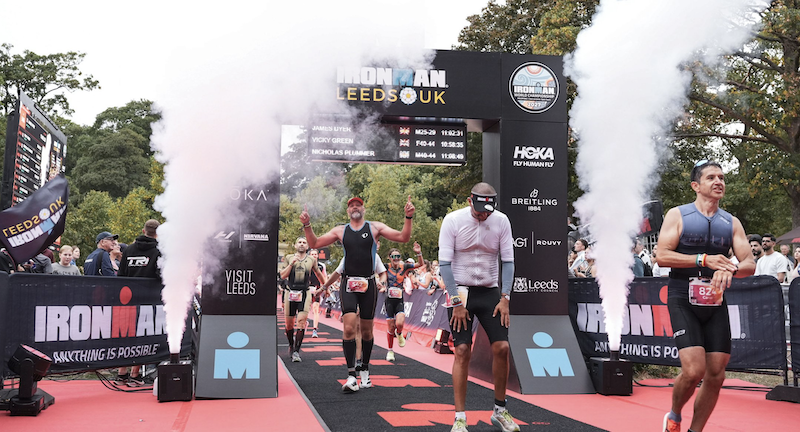
The vibes at the end were everything the start wasn’t. The red carpet, deep crowds of spectators (including my kids with their home made signs), noise, fireworks, people ring the first timer bell, and the words “you are an Ironman”.
I did not get a cringe worthy finish line photo to make my social media profile picture. Four of us had spent the last few km together and carefully choreographed a plan to come down the carpet with some daylight between us, but our arrangement was then swamped by people sprinting past for a personal best that had, on the day, a heavy asterisk on it anyway due to the lack of a swim. I’m sure there’s a metaphor in there somewhere.
The post-race event village was rammed and generally fun, But to continue the comparison with Wales, the food was worse than Tenby. A whole pizza at midnight was one of the greatest meals of my life. A cold burger in a marquee in Roundhay is a cold burger in a marquee. They also gave us some tart cherry juice because marketing but the beer was very welcome.
Sadly my kids are too young to stick around for the evening party and I had no other way of getting to my bed for the night (my undercarriage definitely wouldn’t have tolerated riding there, let alone my legs), so I had to check my bags out of transition and make my way back up the hill to the carpark. And it was, as everyone warned me, worse than the infamous Outlaw staircase.
What is an Ironman?
By the time I got back and showered inevitably the question that was already running through every race Facebook group was: Is it an Ironman if you didn’t swim?
It’s a tricky one. It’s a full-distance bike-run, it’s a bloody hard day out, and I’m proud of it. But it’s probably not an Ironman per se. The distance isn’t really the point - the sequencing is. The whole design of the thing is that you arrive at 180 km of bike already 90 minutes (at least, in my case) into fatigue, your shoulders and your core wrecked, and your heart rate spiked in a washing machine of other peoples’ limbs and possibly jellyfish. Remove that aspect and the bike is a different bike. My legs on that first climb were fresh in a way they have never been at any triathlon. Anyone claiming this was equivalent is arguing in bad faith, and everyone knows it, which is exactly why the question keeps getting asked.
But on the other hand, everyone on that start line will have trained for the swim, as they had the bike and the run. The race itself is just the icing on six to twelve months worth of work. It’s like sitting a post-graduate exam - sure, you’ve got to pass it (or beat the time cut off), but its all the work you’ve put in first that make you a FRCA, not just your performance on the day. Nobody was just rocking up on the day and chancing it because the swim was cancelled.
So if we had to name it, then by distance it’s 98.3% of the race. The standard atomic weight of iron is 55.845u, making this 54.9u: A manganeseman.

I won’t be getting that as a tattoo on my calf.
Leeds vs Wales
I know I keep coming back to it, but the comparison is the most interesting thing about racing Leeds, and it’s not really the course that makes it.
When you’re in Wales, the entire town of Tenby knows the Ironman is happening. Leeds did not seem to notice. In Tenby, the town is the race for a weekend: shop windows, food everywhere including the fire station, a cliff-top swim start, finishing in the centre, and 10,000 people who have organised their year around it. Leeds hosted an event in a park in the north of the city while the other 800,000 residents got on with their Sunday. Some of that is a fair criticism of the venue choice, but some of it is just what happens when you drop an event into a city large enough to absorb it without noticing.
The villages were superb. They all genuinely turned out, like mini-Tenbys with flags flying and parties in the streets. So did Roundhay. The support wasn’t lacking. It was just local rather than civic.
But the economics of it tell the real story. Leeds City Council put last year’s inaugural edition at an estimated £7m for the local economy, and made a big deal out of Leeds being one of only two UK locations hosting a full branded Ironman this year, with Pembrokeshire the other. For Wales, a 2025 economic impact assessment put athlete, spectator, supplier and organiser expenditure at just over £7.3m across 3,000 Ironman athletes and 2,000 IronKids participants, and on the strength of this councillors backed a new host agreement covering 2027–2029.
| Leeds | Wales | |
|---|---|---|
| Estimated economic impact | ~£7m | ~£7.3m |
| Athletes | ~2,500 | 3,000 (+2,000 IronKids) |
| Host population | Leeds district, ~830,000 | Tenby ~4,900; Pembrokeshire ~123,000 |
This is essentially the same income, but impacting populations two orders of magnitude apart. In Tenby that £7.3m is a structural feature of the town’s annual economy, extending Pembrokeshire’s tourism season well past the summer crowds and supporting hotels, restaurants and shops. In Leeds, £7m against a city economy north of £25bn is a essentially a rounding error.
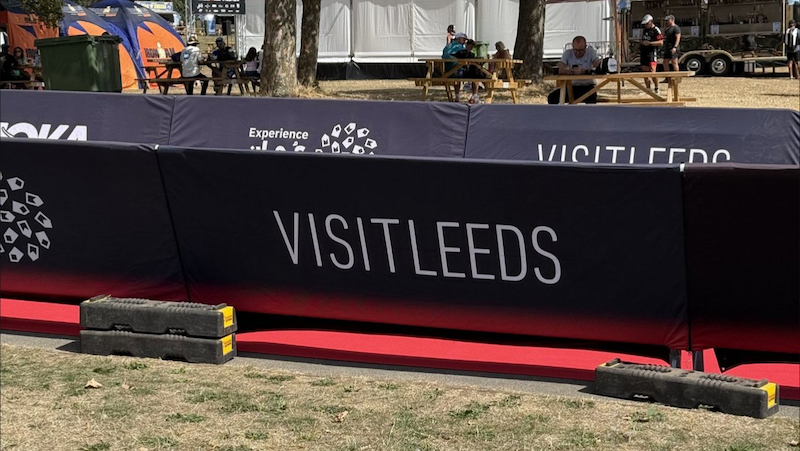
That asymmetry explains the atmosphere gap, and it explains the politics too. In Tenby the disruption is enormous and the argument about whether it’s worth it is a live, genuinely contested civic debate. In Leeds the disruption is concentrated on villages that get very little of the upside and no say. Harewood Parish Council recorded that it was not consulted by either the organisers or the council before the event was planned, with residents and businesses raising concerns about disruption.
Bolton itself sat somewhere between the two for fifteen years, as a mid-sized town where the race was a genuine civic fixture, but and has now dropped to 70.3 distance, which tells its own story about where and how the economics of these events work.
“Ironman Roundhay”
The other persistent complaint is that this isn’t really IM Leeds. Even if the swim had happened, it’s IM Roundhay Park. The swim, transition, the finish, and the entire marathon happen inside or immediately around one park. The bike goes north into the villages and comes back. Leeds city centre is not involved at any point.
As mentioned earlier, the Tour de France Dales route that had been rumoured never happened, but neither did a return to the 2017 WTCS Leeds run course which started in Roundhay but finished in Millennium Square. Ironman have gone with loops close to Leeds and a park-centred layout explicitly because looped courses give spectators more to see, and this concentration is defensible on its other merits - it’s cheaper on road closures, and vastly easier to marshal. But it does mean the race is small-part-of-Yorkshire-flavoured rather than Leeds-flavoured, and it forfeits any chance of the thing Tenby has, which is a whole town in on the joke and on the whole happy to have it here.
One floated solution to the algae problem would be to move the swim to Eccup Reservoir, which would solve many of the issues that plague the lakes in Roundhay. But then there’s no swimming infrastructure there, would need a split transition/finish which athletes tend to hate, and moves the focus of the racing even further out of Leeds.
Take homes
Aside from a couple of PF&H branded bottles, almost making up my admission fee in Maurten, and an over-priced hoodie (and shirt, and hat) what else am I taking away from Leeds?
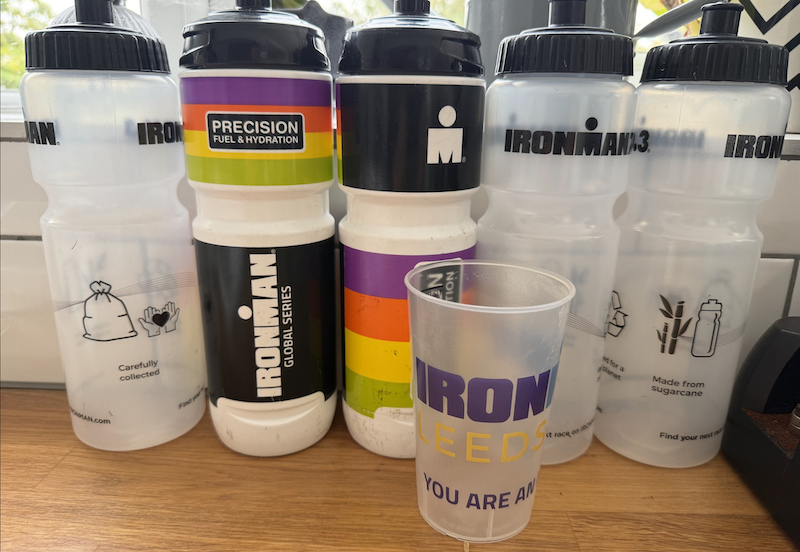
I want to say that I’m fitter than when I did Wales, But the data can’t objectively tell me. Finish times can’t answer it, because of the confounding lack of swim in addition to subtly different courses. No 90 minutes of upper-body work before the bike, no wetsuit, no cold, and a bike leg started on genuinely fresh legs. That alone is worth more than any training block I did in the last twenty four months.
Nor is Leeds obviously “easier” than Wales in the sense people mean. Both bike legs sit in the top few percent of IM courses for elevation per kilometre, and the four-lap marathon is hillier than most too. Leeds is not a soft course. It’s a different hard: repeated short steep efforts rather than Wales’s long grinding exposure and sea swim.
The way to actually answer it is to ignore times entirely and compare the physiology across the two, which one day I might get around to. But maybe the real treasure was the friends we made along the way: The training and discipline to be able to do this race, the focus this year on strength and conditioning that I’ve never had before, and improved performance at supporting events such as Dragon Ride all point towards the training for Leeds benefiting me physically and psychologically.
Would I do it again? Probably not. There’s not really any novelty in it. It’s a good race, but the thing I got out of Leeds was seeing what it was. That’s done now. I’ve already swum that lake so whatever the swim would have added, I’ve had it, other than the impact it would have on my bike and run.
Plus unless they move either the date or the location of the swim, there’s a huge recurrence risk. The algal bloom wasn’t a freak event, but a predictable outcome from heat plus drought plus a nutrient-loaded urban lake fed by combined sewer overflows. The nutrient loading is chronic and won’t be fixed quickly. The heat is only trending in one direction. Move the race to mid-August in perpetuity and you’re rolling the same dice annually. I don’t fancy paying full price for that lottery ticket twice, although it might be different if they offered a discount on next year, like Outlaw did after their own algal bloom.
Finally, really I want a harder race, not a different one. Leeds was genuinely challenging, and it was both well-run and well-supported, but now I’ve finished it I’m wanting something with more teeth in it. I don’t think I could ever go back to Wales because it would be impossible for it to be worse weather, and that would ruin the experience. I’m thinking maybe something with a proper mountain. Or moving away from triathlon for a year or two, and trying something considerably longer and much slower, where six hours is a warmup and nobody has ever heard of a variability index.
I’m open to suggestions!